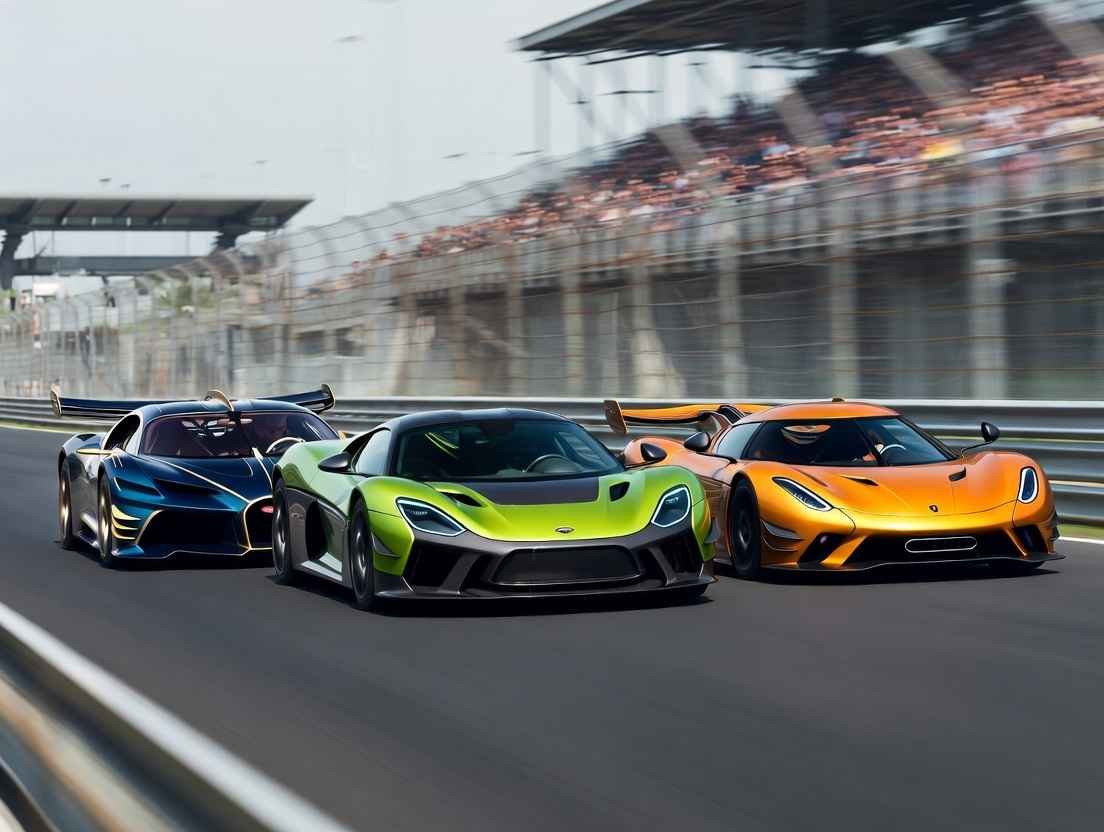
The Best Racing Cars brings you the most exciting hypercar battle of 2026: Bugatti Tourbillon vs. Rimac Nevera vs. Koenigsegg Jesko. These three amazing cars set the standard for car performance in 2026. Each one excels in a different area of speed, engineering, or driving excitement. The Bugatti Tourbillon offers a revolutionary hybrid V16 experience that combines luxury with huge power. The Rimac Nevera, especially its R version, is the fastest electric hypercar on the market right now. The Koenigsegg Jesko, in both Absolut and Attack forms, is the best at pure internal combustion, with the best top speed and the most accurate weight. This comparison looks at acceleration, top speed, handling, price, and the heated debate over hybrids, electric cars, and pure ICE to find the best hypercar of 2026.
Acceleration: A battle of instant power delivery
Acceleration is what makes hypercars different from regular supercars, and the Rimac Nevera is clearly the fastest. The Nevera’s R model can go from zero to sixty miles per hour in about one point six six seconds and from zero to one hundred kilometres per hour in one point seven two seconds. It has four electric motors that give it over two thousand one hundred horsepower and instant torque vectoring. This electric setup gives you the best low-end response without any turbo lag or gear shifts. The Bugatti Tourbillon comes in second, going from zero to one hundred kilometres per hour in just two seconds thanks to its one thousand eight hundred horsepower hybrid system. The naturally aspirated eight point three litre V16 engine gives it one thousand horsepower, and three electric motors add eight hundred more for explosive launches. The Koenigsegg Jesko is a little slower than the others when it comes to straight-line sprinting. It can go from zero to one hundred kilometres per hour in about two point five seconds on E85 fuel, thanks to its one thousand six hundred horsepower twin-turbo V8 and nine-speed Light Speed Transmission, which makes quick but combustion-dependent shifts. The Nevera wins in acceleration metrics among the ultimate hypercar 2026 contenders for pure launch drama.
The Velocity Crown is the fastest speed.
When it comes to hypercars, the top speed is still the most important bragging right. The Koenigsegg Jesko Absolut has the highest theoretical speed, with a projected speed of over 310 miles per hour (500 kilometres per hour). This is because it has a very low drag coefficient of 0.278 and a streamlined low-downforce design. Real-world tests have shown that it can go as fast as 430 kilometres per hour, making it the fastest car for long-distance high-speed runs. The Bugatti Tourbillon can go up to 277 miles per hour (445 kilometres per hour) with its optional speed key. This shows that it has strong hybrid-assisted pull at very high speeds, but it can only go up to 236 miles per hour (236 kilometres per hour) without it for safety. In verified tests, the Rimac Nevera R can go 267 miles per hour (431 kilometres per hour). It has consistent electric thrust, but battery thermal management and aerodynamics limit its speed at long peaks. The Jesko Absolut is the fastest ultimate hypercar of 2026, and it’s the best choice for people who want to break speed records.
Handling: Track Accuracy and Movement
Handling shows how each hypercar behaves in corners and other dynamic situations. The Koenigsegg Jesko Attack variant has up to 1,400 kg of downforce from its active aerodynamics and huge rear wing. It also has a lightweight carbon monocoque that weighs about 1,390 kg dry, making it very stable on circuits and able to turn in very quickly. Its triplex damper system and precise steering give you feedback that keeps you interested. The Rimac Nevera has advanced torque vectoring that lets each wheel get its own power, which gives it better grip and agility. It has set many lap records around the world, even though it weighs 1,950 kilograms (4,200 pounds) at the curb. The Bugatti Tourbillon has advanced suspension and active aero that make it easy to drive on all four wheels. However, its 2,000-kilogram weight and grand tourer design mean that it is better for balanced road performance than pure track aggression. The Jesko Attack has the best handling for drivers in this ultimate hypercar 2026 trio when it comes to circuit dominance.
Cost and Uniqueness
The price shows how rare and well-made these machines are. The Bugatti Tourbillon costs about four point one million dollars, but with custom options, it can cost more than four point six million dollars. Only two hundred fifty units will be made, making it very rare. The Rimac Nevera starts at about $2.2 million and goes up to $3 million for the R variant, which has 150 examples. This makes it relatively easy to get into the hypercar market. The Koenigsegg Jesko costs between three million and three point eight million dollars for its one hundred twenty-five units, which are split between Absolut and Attack configurations. This shows how much work went into the Swedish engineering. The Nevera has great performance for the money, while the Tourbillon and Jesko cost more because of their history and cutting-edge technology in the ultimate hypercar 2026 market.
Electric, hybrid, and pure ICE: The Debate Over the Drivetrain
In 2026 hypercars, the drivetrain philosophy is a hot topic. Hybrids like the Bugatti Tourbillon combine the emotional sound of a naturally aspirated V16 engine with electric torque to give them a wide range of performance options, such as short all-electric ranges and better fuel economy. Electric hypercars like the Rimac Nevera can give you instant, silent power with no emissions and little maintenance. However, they can’t go as fast for as long because of battery heat limits. The Koenigsegg Jesko has pure internal combustion engines that keep the raw mechanical feel, high-revving excitement, and lightweight benefits without adding battery weight. This makes it appealing to purists, even though it sacrifices some efficiency. Hybrids keep things balanced in the world of hypercars in 2026, electric cars lead the way in terms of sustainability, and ICE keeps things interesting.
A look at the specs comparison table
The Bugatti Tourbillon has a starting price of $4.1 million, a top speed of 445 kilometres per hour with the speed key, and a curb weight of about 2,000 kilograms. It has 1,800 horsepower and can go from 0 to 100 kilometres per hour in two seconds. The Rimac Nevera R has an all-wheel-drive electric powertrain that gives it over 2,100 horsepower. It can go from 0 to 100 kilometres per hour in 1.72 seconds and has a top speed of 431 kilometres per hour. It weighs about 1,950 kilograms and costs $2.2 million. The Koenigsegg Jesko has a rear-wheel-drive twin-turbo V8 engine that makes one thousand six hundred horsepower on E85. It can go from zero to one hundred kilometres per hour in about two point five seconds and is expected to reach a top speed of over five hundred kilometres per hour. It weighs about one thousand three hundred ninety kilograms and costs three million dollars to buy.
Personal Ranking: A Controversial Opinion
The Koenigsegg Jesko is the best hypercar of 2026 because of its pure mechanical design, lightweight construction, and engaging driver connection that electric systems can’t match. The Bugatti Tourbillon comes in second because it has a luxurious hybrid refinement and an emotional V16 experience. The Rimac Nevera is in third place because electric hypercars are still a little overrated in 2026. They have amazing performance numbers, but they don’t have the visceral engine character, exhaust note, and soul that make driving so exciting.
These ultimate hypercar 2026 icons show a wide range of engineering paths, from electric innovation and hybrid luxury to combustion extremes. People who are interested in them rate them based on things like how fast they can go, how well they can handle corners, or how much they get into them. As the hypercar market changes, hybrids offer thrills without making any sacrifices to tradition.
In the end, the Bugatti Tourbillon, Rimac Nevera, and Koenigsegg Jesko rivalry shows that there are different ways to be the best in the hypercar world of 2026. Each one sets the bar for high-performance cars, exotic sports cars, and racing-inspired engineering that fans all over the world love.